Beyond the Spreadsheet: Managing Assets and Equipment in a System of Record
Spreadsheets are where most asset and equipment tracking starts, and they work fine until the operation grows. Asset management is relational, time-based, and auditable by nature, and those are the three things a spreadsheet handles worst. Once you are past a few dozen assets, the answer is a configurable system of record where every asset carries its own live history and connects to everything around it.
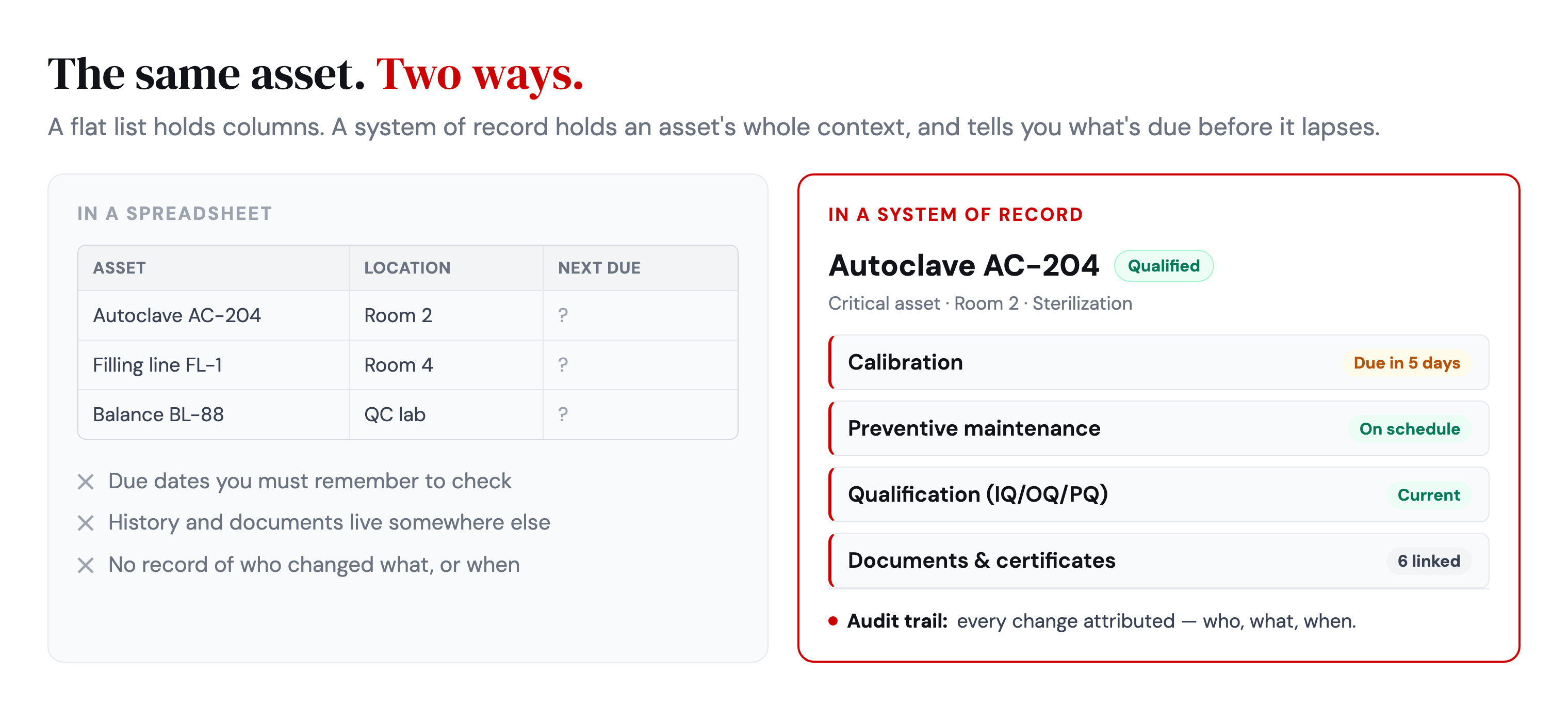
Asset tracking is harder than it looks
On the surface, tracking assets seems simple: a list of things, where they are, and their status. In practice, every asset drags a web of information behind it, and that web is exactly what makes a flat list fall apart:
- It is relational. An asset is tied to a location, an owner, a maintenance history, a calibration or inspection record, a warranty, a parent system, and the people who touch it. A spreadsheet can hold columns, but it cannot hold relationships.
- It is time-based. Assets have due dates: maintenance intervals, inspections, calibrations, warranty expirations, contract renewals. The value is in knowing what is due or overdue right now, not in a static snapshot.
- It has to be trustworthy. For anything regulated, audited, or high-value, you need to know who changed what, when, and why. A spreadsheet cell can be overwritten with no trace.
Miss any one of those and the list becomes a liability rather than a source of truth.
Where spreadsheets and siloed tools break down
The failure is predictable, and it is rarely the fault of the people running it:
- No reliable "what's due" view. Due dates live in a formula someone has to remember to check. Something lapses, and now you have an asset out of service, out of warranty, or out of compliance without anyone noticing.
- The record is scattered. The asset is in one sheet, its service history is in an email thread, its purchase record is in a finance system, and its inspection certificate is in a shared drive. Reconstructing the full story of one asset takes far longer than it should.
- No audit trail. When a number changes, there is no record of who did it or why. That is fine until an auditor, a customer, or an incident review asks.
- It does not scale across teams or sites. Two locations quickly become two different spreadsheets, two different conventions, and two different ways to be out of date.
The root problem is that asset management is a connected discipline, and spreadsheets and single-purpose tools keep the pieces apart.
What a system of record does differently
The operations that stay on top of their assets share one trait: a single connected system where every asset holds its own complete, current record. Concretely, that means:
- One record per asset, with its status, location, ownership, and full history in one place.
- Relationships, so each asset links to its maintenance, inspections, documents, parent systems, and the people and places around it. The context travels with the asset.
- A live due and overdue view, so nothing silently lapses, across every asset and every site.
- Repeatable checklists for the recurring work, inspections, maintenance, onboarding, or decommissioning, executed the same way every time.
- An attributable audit trail on every change, so the record holds up to scrutiny.
- An at-a-glance board, so leaders can see the state of the whole estate without asking anyone to build a report.
When that exists, "show me everything about this asset" is one click, and readiness stops being something you scramble to prove and becomes something you simply are.
Why "configurable" is the part that matters
Most asset tools fail for the opposite reason spreadsheets do: they are too rigid. They assume your assets, your fields, and your workflows look like everyone else's, and they force your process to bend to the software. Real operations do not work that way. A vehicle fleet, a set of lab instruments, IT hardware, facility equipment, and regulated production assets each need different fields, different lifecycles, and different checks.
That is the case for a no-code, configurable system of record, one where you define the item types, the fields, the relationships, and the status workflows to match how you actually operate, without a development project. ArcTracker, the tracking module of ArcSuite AI, is built exactly this way: configurable item types and relationships, checklists for recurring work, status roll-ups and board views for what is due or out of compliance, and a full audit trail on every action. The tool bends to your process instead of the other way around.
The payoff
Good asset management is not overhead, it is what keeps equipment running, inspections calm, audits short, and money from leaking out through lapsed warranties and missed maintenance. Get every asset and its full lifecycle into one connected, auditable record, and you trade the spreadsheet scramble for an operation that is always current, and always ready to show it.
See your assets in a system of record.
ArcTracker models your equipment and assets, with their full history, relationships, and audit trail, in one configurable, no-code record. Book a working session and we'll map it to your workflows.
Frequently asked questions
Why do spreadsheets fail for asset management?
Asset management is relational, time-based, and auditable, and spreadsheets handle all three poorly. They hold columns but not relationships, they show a static snapshot rather than what is due right now, and a cell can be changed with no record of who did it or why. Past a few dozen assets, the spreadsheet becomes a liability rather than a source of truth.
What is a system of record for asset tracking?
A single connected source where every asset holds its own complete, current history: status, location, ownership, maintenance and inspection records, related systems and people, and a live view of what is due or overdue, with every change captured in an audit trail.
What should an asset management system track?
Beyond a basic inventory: each asset's status, location, and ownership; its relationships to maintenance, inspections, calibrations, documents, and parent systems; its recurring due dates; and a full attributable history of every change. Recurring work like maintenance and inspections is best handled as repeatable checklists.
Why does a configurable, no-code asset system matter?
Rigid tools force your process to bend to the software. A vehicle fleet, lab instruments, IT hardware, and regulated production assets each need different fields and lifecycles. A no-code, configurable system lets you define item types, fields, relationships, and status workflows to match how you actually operate, without a development project.
How does an audit trail help with asset management?
It records who changed what, when, and why on every asset. For anything regulated, audited, or high-value, that attributable history is what lets you answer an auditor, a customer, or an incident review with confidence, and it is exactly what a spreadsheet cannot provide.